Why CFOcoaching.com?
I’ve spent most of my career in and around finance.
I’ve worked with accountants, controllers, finance teams, CFOs, CEOs, founders, boards, and business owners. I’ve worn a variety of hats along the way, but finance leadership has always been my home.
It’s where I built my career.
It’s where I built my reputation.
It’s where I earned my learning.
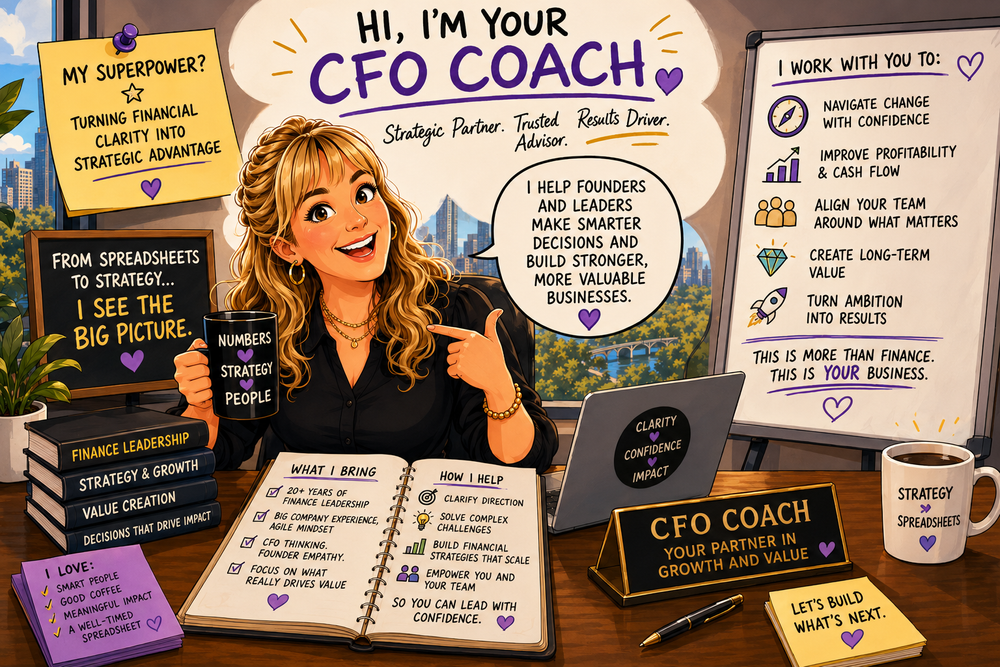
So why would I, Jamie L. Smith start CFOcoaching.com?
Because over the years I’ve become convinced that many of the challenges facing CFOs have very little to do with finance. I believe the profession's biggest challenge is leadership.
CFOs do not lack capability.
In fact, I think many CFOs are among the most capable people in their organizations. They are often my favourite - the one I recognize and the one I understand. The problem is that too many don’t first show up as business leaders.
And most don’t even realize they’re doing it. I’ve seen strategy sessions planned around a budget with the assumption that becomes the strategy. I’ve seen conversations about AI reduced to cost savings and efficiency gains while completely missing the implications for revenue. The investment isn’t considering growth, competitive advantage, and the actual strategy.
I’ve seen finance leaders protect profitability in businesses that were slowly becoming irrelevant. Leaders pushing for sustainability and using controlled costs and rising cash flow as evidence of growth, while revenue, brand, and growth slowly slipped away.
None of these decisions are made because CFOs aren’t intelligent. They’re made because many finance leaders have been trained to see the business through a financial lens first. And a leadership lens second, if at all.
The world is changing too quickly for that approach. The CFO role is changing. AI and technology are changing it. The expectations of CEOs, boards, and business owners are changing it.
The future belongs to finance leaders who can connect numbers to decisions, strategy to execution, and technology to business outcomes.
In my view, the future CFO is not a better accountant. It doesn’t surprise me at all that less than fifty percent of CFOs are CPAs and I don’t see that decline improving.
The future CFO is a better business leader. That’s why I’m writing these. And it’s why I’m carving out time to coach Finance Leaders with CFOcoaching.com. Not to talk about accounting standards. Not to review software features. Not to chase every new trend. And not for nostalgia.
I want to keep helping the accounting and finance community. My new business does not place accounting and finance positions in Western Canada. Locally, it does not work in the space at this time. We are active in other markets and it’s been a great opportunity.
Double U Advisors is a leadership firm focused on redesigning leadership and solving the CEO bottleneck. We place Fractional Leaders in the areas CEOs get pulled back into- Operations, Marketing, Sales and HR. When capacity is not needed, we offer Leadership Liftoff and coaching, advisory, and consulting. We train Fractional Leaders on AI and Connection and Fractional Leadership.
Personally, I am taking a limited number of out time Finance Leaders coaching clients through CFOcoaching.com, and I am open to working as a Fractional CFO personally with the right business, CEO, and Controller.
I am grateful for the opportunity to branch out, but I am prepared and expecting to reevaluate. In the meantime, I am staying relevant and contributing where I can, including introducing this blog.
I’m writing to explore what it means to become a more effective finance leader in a world being reshaped by AI, changing business models, and new expectations of leadership.
I’ll be sharing ideas, observations, challenges, and lessons from across the finance profession and beyond. Some of what I write will be uncomfortable. Some of it may be wrong.
But my goal is simple: To help finance leaders think bigger, lead better, and create more impact than they thought possible. Because I believe this is a group of leaders I can help and understand.