Working Capital is a Team Sport (Working Capital - Part 2)
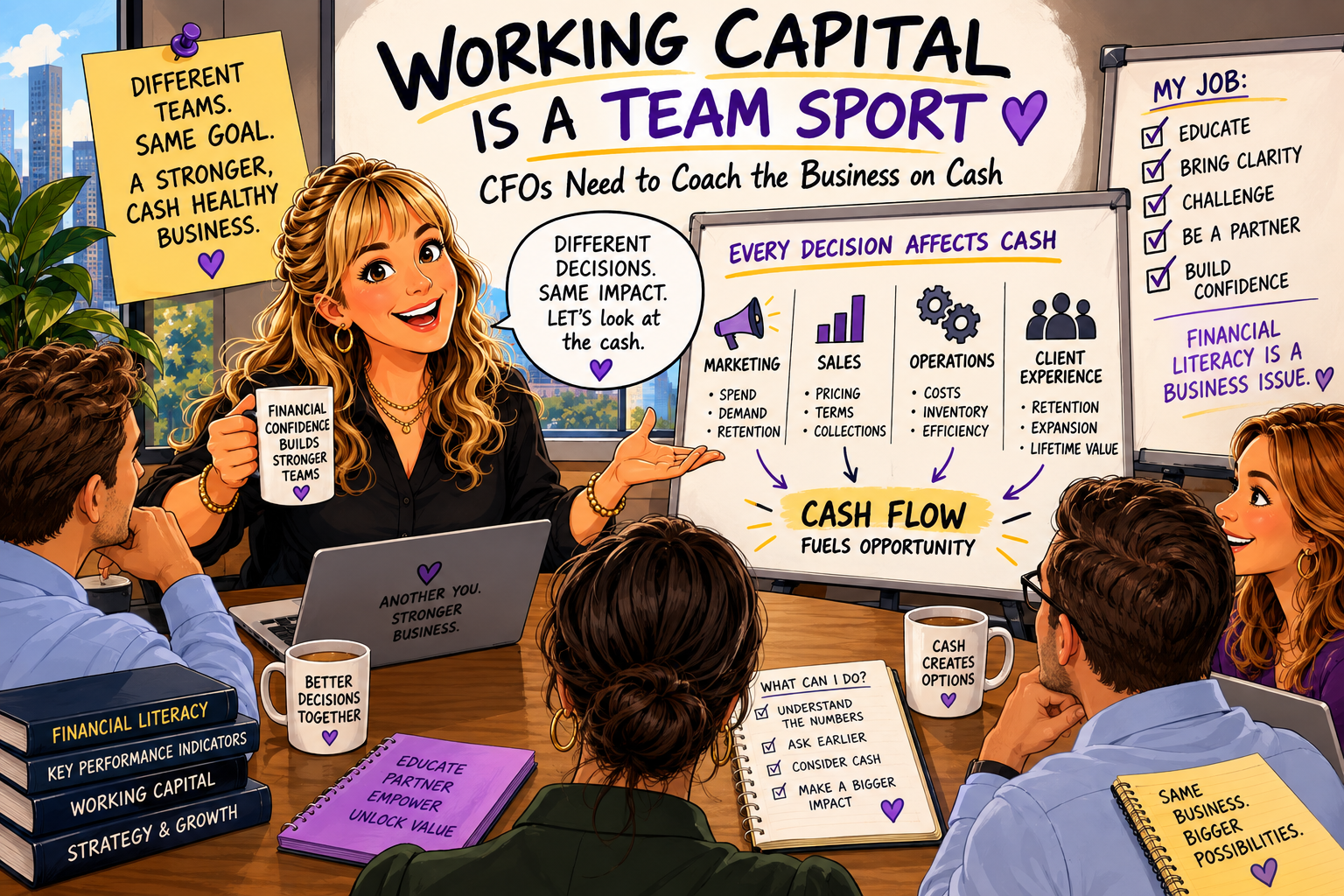
Working Capital Is a Team Sport: CFOs Need to Coach the Business on Cash
We promote people into leadership roles that affect financial performance long before we give them meaningful financial accountability or teach them how to understand it.
Think about that.
Leaders across marketing, sales, operations, client experience and other areas make decisions every day that influence revenue, costs and cash.
Yet, many have never owned a profit and loss statement, been taught how working capital works, or been shown how their decisions affect cash.
Business owners and CEOs often struggle with financial literacy too.
Whose job is it to fix that?
It’s the CFO’s.
Financial literacy is a business issue, not a finance issue.
I’ve written about financial literacy before because I think we underestimate its impact.
The best finance teams take responsibility for educating the business. They give people the reports and analysis they need, but more importantly, they help people understand what those numbers mean and how to use them.
That’s the difference between reporting numbers and leading a business.
And that responsibility carries real weight.
When leaders don’t understand how the company makes money, the economics behind their decisions or their role in cash flow, we shouldn’t be surprised when their decisions don’t align with the financial strategy.
Consider marketing.
Your Chief Marketing Officer is frustrated because they don’t have enough budget to hit their goals or consistently build brand and demand.
At the same time, for example, they may not understand the economics of acquiring a new client compared with retaining an existing one.
So they keep investing externally to find new clients while deprioritizing requests from the client experience team for collateral and materials that support existing and repeat clients.
They may see $1 as $1.
But financially, $1 spent in two different places can produce very different outcomes.
The same is true of revenue.
$100 from a new client and $100 from an existing client may look identical on the top line, while the economics behind those dollars can be quite different.
If no one teaches the marketing leader that, why would we expect them to know?
Especially when their key performance indicators reward new-client acquisition while responsibility for existing clients sits somewhere else.
This is why the right key performance indicators matter.
Good key performance indicators do more than measure performance.
They help leaders understand the business.
Gross margin can expose where profitability is disappearing. Customer retention can change how marketing thinks about growth. Labour costs relative to revenue can help operations make better staffing decisions. Cash flow measures can show why growing sales doesn’t necessarily mean there is cash available to spend.
The number isn’t the point.
The point is the decision it helps someone make.
And working capital takes this challenge another level deeper.
The people spending money in your company probably aren’t thinking about payment terms.
They may consider price.
Hopefully, they consider budget.
But are they thinking about when cash leaves the business?
A billboard requiring a full-year contract paid upfront doesn’t have the same working capital impact as Meta ads that can fluctuate, be cancelled, and are charged as they run.
Even if the annual cost is comparable.
That distinction rarely appears in the budget or decision-making filters of the people spending the money.
The same thing happens on the revenue side.
Sales teams may negotiate price without thinking enough about deposits, milestones, payment schedules or collection terms.
Those decisions affect cash.
And financial literacy alone isn’t enough.
This is where the CFO’s role becomes even more important.
The right working capital decision differs by company.
For one organization, the administration or financing costs associated with a long payment plan may make paying upfront the smarter decision.
Another company can create serious cash pressure if payment timing isn’t strategically designed into a contract.
So you can have smart, financially literate leaders who still don’t know what a good working capital decision looks like inside your organization.
They have to be taught.
CFOs, that lands with us.
If you are sending reports and wondering why they have little impact on decision-making, this may be part of the answer.
If you are giving direction and wondering why finance is seen as the department saying “no,” this may be part of the answer too.
I’ve worked with far too many CFOs, lawyers, and leaders who think they should be listened to. That translates to being obeyed. They do not see that their job is to be understood - here’s where the financial risk lies. Or the legal risk. Or the brand/people/technology/process/etc risk. That is the actual job - to be heard and understood so that the person who is making the final call knows where the landmines are. And so you can use your role and expertise to help them mitigate risks that are anticipated but evaluated as worthwhile. The job is never to be obeyed at a CFO or leadership level. It is to challenge, be challenged, and be part of the opportunity and solution.
The reality is that the risk profile of the average business owner, founder, or CEO is vastly different from that of a typical CFO. And guess what? If you have that risk profile, you might have the top job too.
Far too many CFOs miss that part of the job description. And if you are trying to be heard and understood on a team that is weak in financial literacy, it’s a hard game. Maybe impossible.
Here’s what you can do.
1. Change how you communicate.
Reports should not just tell people what happened.
Help them understand why it matters and what decision should change as a result.
And communicate for the audience.
Marketing may need visuals. Operations may need specific unit economics. Sales may need to understand how contract terms affect cash. Executives may need trends and scenarios.
Use visuals, videos, colours, graphs, bullets and the language of the team.
2. Get involved before the decision.
Train leaders to see finance as a business partner who can help with negotiations, contracts, pricing and decision-making.
The CFO should be someone people call before the deal is structured, not after it is signed.
That requires finance to earn the invitation.
3. Teach financial literacy.
Hold sessions where people can learn without the pressure of an urgent decision sitting in front of them.
Start simple.
Revenue. Gross margin. Profit. Cash flow. Working capital. The key performance indicators that actually drive your business.
Then make the education specific to your organization.
What does good look like here?
What decisions create cash pressure here?
What should someone in marketing, sales or operations understand before committing the company to something?
Financial confidence doesn’t come from giving someone another dashboard.
It comes from helping them understand what they are looking at and giving them the confidence to use it.
Every time someone reaches out to finance, there is an opportunity to do more than answer the question or check something off a list.
Help.
Coach.
Teach.
Working capital is a team sport.
The CFO’s job isn’t to play every position. It’s to make sure the team understands the game.