ERP Extinction? Are You Really Outgrowing QuickBooks?
Quick Answer: Outgrowing QuickBooks doesn't automatically mean you need an enterprise resource planning (ERP) system. In October 2026, NetSuite moved down market, Intuit moved up and Xero put live accounting data inside an artificial intelligence (AI) assistant. Before you migrate, answer three questions: What problem can't we solve today? Which controls truly need deeper integration? What's the real cost and the real return?
Don't you hate it when someone decides you've outgrown QuickBooks before asking what problem you're actually trying to solve?
For years, finance leaders have been told the same story.
You'll outgrow QuickBooks.
More revenue. More people. More transactions. More complexity.
Then it's time to graduate to an ERP system.
But is it?
I'm less convinced. And October 2026 gave me three good reasons to question it.
[IMAGE: A business leader at a crossroads between a simple accounting dashboard and a complex ERP system map | Alt text: Business leader deciding whether they are outgrowing QuickBooks]
Why is the ERP market getting squeezed from both ends?
Three announcements. Two days.
NetSuite moved down. On October 14, Oracle NetSuite launched QuickStart, a free financial platform built on AI for eligible early-stage technology startups in the United States.
Intuit moved up. On October 15, Intuit agreed to acquire Sequence, a revenue management platform, pushing QuickBooks further into the mid-market.
Xero changed the front door. On October 14, Xero launched a Google Gemini integration that puts live accounting data inside an AI assistant.
The ERP vendors want you earlier. The accounting platforms want to keep you longer. And AI is making it matter less which system your data lives in.
That's more than a market update on software.
[IMAGE: Simple timeline of October 14 and 15, 2026: NetSuite moves down, Intuit moves up, Xero adds AI | Alt text: QuickBooks vs ERP market shifts in October 2026]
Why did we ever need ERP?
The pitch was good.
One system. One source of truth. Less manual entry. Better controls. Real reporting. Room to scale.
The reality? Often less good.
Implementations run long, cost more than budgeted and disrupt the finance team for months.
In 2024, Gartner predicted that more than 70% of recently implemented ERP initiatives will fail to fully meet their original business case goals by 2027.
That's a sobering statistic for investments that can run into the hundreds of thousands or millions of dollars.
If your team delivered that kind of result on another major investment, you'd have some explaining to do.
[IMAGE: Stat graphic: 70% of recent ERP initiatives expected to miss their business case goals by 2027 (Gartner) | Alt text: ERP implementation failure statistic from Gartner]
Now AI is chipping away at the original business case.
You don't necessarily need one platform to see information across systems.
You don't always need ERP to automate workflows, reconcile transactions or produce serious reporting.
Integrations, specialized applications and AI can increasingly do that while your accounting system stays put.
I'll admit I didn't see this coming. I didn't predict that mapping and integrations would matter less. I didn't see the adage "garbage in, garbage out" being questioned.
Here's the distinction that matters:
Outgrowing a feature in QuickBooks is not the same as outgrowing QuickBooks.
Does ERP still earn its place?
Don't write the obituary yet.
ERP still earns its place in some businesses.
Complex manufacturing. Serious inventory. Multi-entity and intercompany accounting. Sophisticated costing. Regulatory requirements. High volumes of interconnected transactions.
And controls. Always controls. I think this is the most critical business case, in fact. This article isn't meant to cover the details, but to highlight how auditing AI work and showing the audit trail is taking up space in business and accounting literature. From basic controls like segregation of duties and chart-of-accounts hygiene to expectations in a Sarbanes-Oxley (SOX) or public-company environment, it's still a challenge without an ERP.
AI can flag exceptions, recommend actions and automate approvals. But you still need a reliable system to authorize, record and protect transactions.
AI makes transaction processing smarter. It doesn't make transaction infrastructure optional.
But here's where I'd push back on the vendors.
None of those needs automatically means an all-in-one ERP.
A business might keep QuickBooks, add a specialized inventory or manufacturing application, and connect it all with integrations and AI.
Will that always be cheaper and more reliable than a full replacement? No.
Will it sometimes be? Absolutely.
And that conversation deserves more airtime before anyone books a demo.
Here's how to match the problem to the fix before you match it to a vendor.
| Your problem | Try first | ERP earns its place when |
|---|---|---|
| Inventory | A specialized inventory application connected to QuickBooks | Inventory, costing and production are tightly linked |
| Reporting | Integrations and AI-assisted reporting | Data lives in too many systems to trust one version |
| Multi-entity and intercompany | A consolidation tool on top of your accounting system | Entity count and intercompany volume make manual work risky |
| Transaction volume | Automation and AI for routine processing | Volume and interconnected transactions outpace your team |
| Controls | Tighter processes, approvals and segregation of duties | You need a full audit trail in a SOX or public-company environment |
The vendors aren't sitting still either
AI cuts both ways.
Oracle is using AI to automate parts of ERP implementation and configuration. NetSuite is building agents that flag exceptions, help match reconciliations and recommend fixes. Acumatica is opening up to external AI tools.
If AI makes ERP cheaper to implement and easier to run, the math changes again.
So two forces are racing:
AI is making ERP easier to avoid.
AI is making ERP easier to buy and run.
My bet?
The biggest casualty won't be ERP software. It will be the traditional mid-market ERP business model.
That's a much bigger change than another round of software features.
What should you ask before you book an ERP demo?
Stop asking when you'll outgrow QuickBooks.
Start asking better questions.
If an ERP business case landed on my desk today, I'd want three answers before anyone booked a demo.
1. What problem can't we solve today?
Name it specifically.
Is it inventory? Reporting? Consolidation? Transaction volume? Internal controls?
Then ask whether a specialized application, automation or AI could solve the problem without a full migration.
Don't replace an entire system because one part of it isn't working.
2. Which controls truly need deeper integration?
Not what's nice to have.
Which transactions genuinely need to live in one system to be authorized, recorded and protected?
Where are the real risks? Where are the actual gaps?
And which problems could be addressed by improving your existing processes and controls?
More software doesn't automatically mean better controls.
3. What's the real cost and the real return?
Look beyond the software subscription.
Implementation. Maintenance. Training. Disruption. Risk. The time your finance team will spend getting the new system working.
Then compare that investment against the alternatives.
What measurable economic benefit will ERP deliver that the alternatives won't?
[IMAGE: Checklist graphic of the three questions: the problem, the controls, the real cost and return | Alt text: Three questions to ask before outgrowing QuickBooks and buying an ERP]
And one rule on top of those three questions:
Compare ERP against what your current systems can do today. Not what they couldn't do three years ago.
That's a very different buying conversation.
And you should lead it.
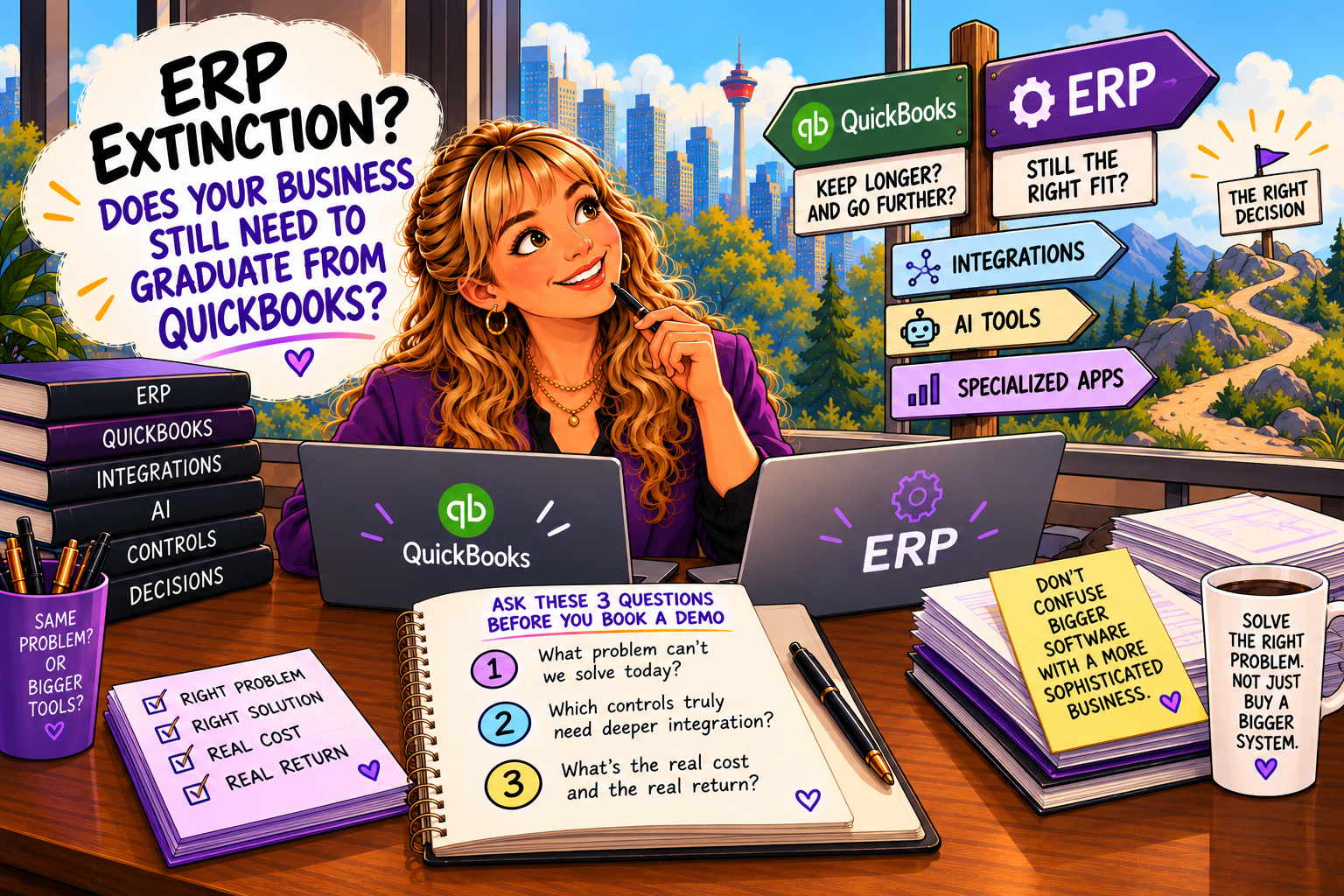
ERP extinction? No. ERP graduation? I'm not so sure.
ERP isn't disappearing.
Growing businesses will always need solid transaction processing, controls and operating systems.
But the idea that every growing business eventually has to graduate to a traditional ERP?
That's getting harder to defend every quarter.
The winners won't necessarily be the platforms with the most features. They'll be the ones delivering the most economic value with the least complexity.
And for finance leaders, that's the real leadership test.
Are you solving a business problem or just buying more sophisticated software?
Don't confuse more sophisticated software with a more sophisticated business.
Before you sign, make sure you're not buying a more expensive way to do what you can already do.
Before you leap, ask better questions
Thinking you've outgrown QuickBooks?
Maybe you have. Maybe you haven't.
Before committing to a costly ERP implementation, make sure you're solving the right problem. Start with the three questions above.
Neither CFOcoaching nor Double U Advisors works in the ERP space, but we want to see finance leaders ask better questions, evaluate their options and make smarter business decisions.