Cash Flow Forecast, Budget, or Financial Strategy? You Need All Three.
Don’t you hate it when the bank balance looks great, the budget says you’re on track, and you still can’t afford the hire you need?
Or when the numbers look healthy, but you have no idea where the business will be in three years?
Here’s what’s usually happening.
You’re asking one financial tool to answer a question it wasn’t built for.
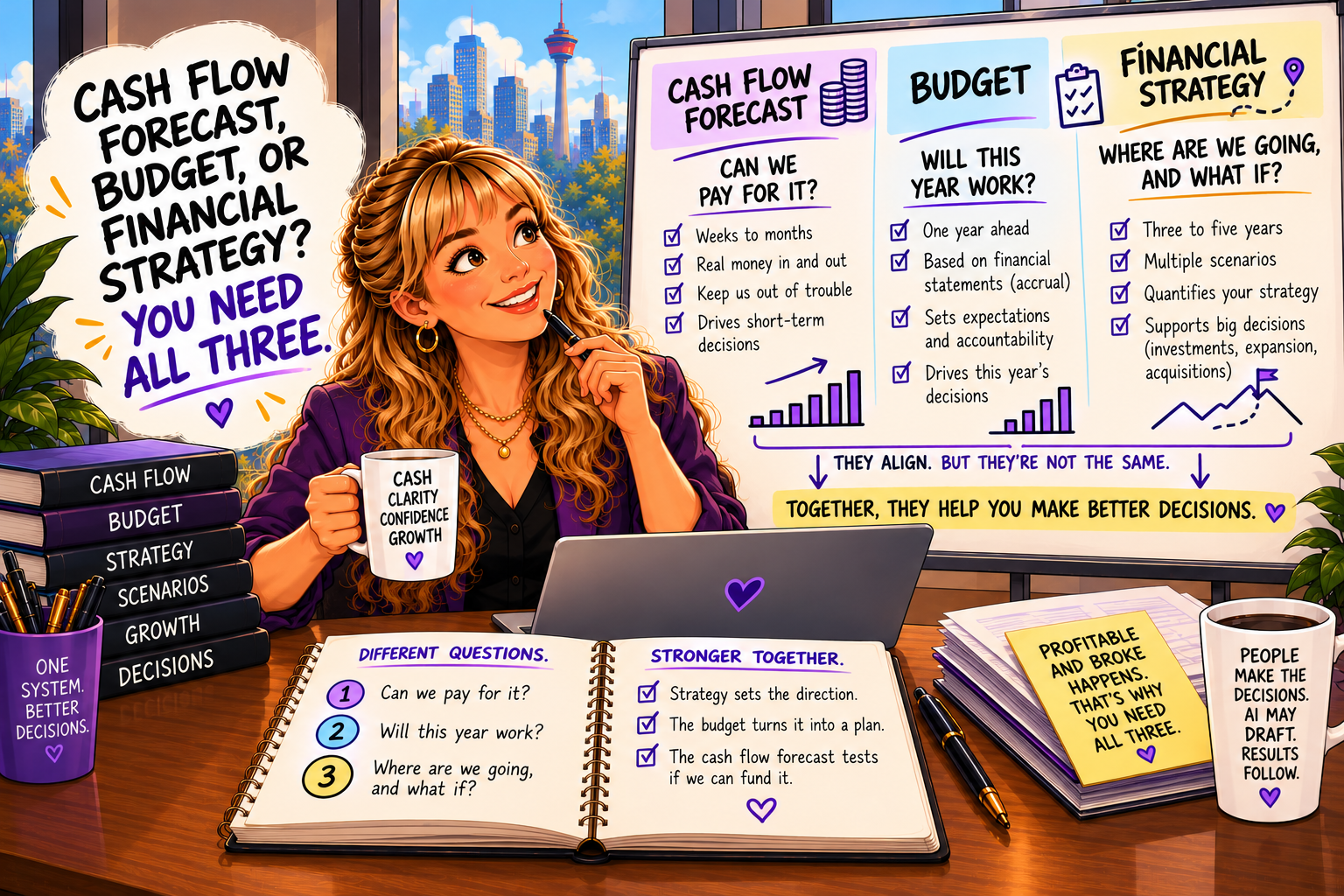
There are three tools. Together they’re the trifecta every growing business needs:
Cash flow forecast. Can we pay for it?
Budget. Will this year work?
Financial strategy. Where are we going, and what if things change?
They align, but they’re not the same. Each answers a different question and drives a different decision.
You’re not alone if this feels blurry. In a Xero survey of Canadian small business owners, cash flow management, long-term financial planning, and budgeting all made the list of top financial literacy challenges.
Cash flow forecast: can we pay for it?
Cash is king. It’s the lifeblood of the business and can be unforgiving.
Your cash flow forecast tracks real money in and out of the bank: when customers actually pay, when suppliers and payroll are due, and when loan payments hit.
Time horizon: weeks to months.
Users: decision makers. Those who make cash decisions need to understand the impacts. Finance and accounting hold this tool to drive their work and recommendations.
Basis: cash, not accounting profit.
Decisions it drives: can we make payroll, take on that order, fund that deposit, or make that hire this quarter?
This tool keeps you out of trouble. It’s also the one most businesses skip until it’s too late.
Budget: will this year work?
Your budget is your one-year plan, built on your financial statements.
It’s accrual-based. Revenue counts when you earn it and costs count when you incur them, not when the cash moves. That’s why it answers a different question than your cash flow forecast.
Time horizon: the year ahead.
Users: it sets expectations for team members. From it they have pre-approvals and can be held accountable. Leaders use it to drive decisions and learnings. Boards, bankers, and other stakeholders often use it for oversight.
Basis: your income statement, often at a department level. Consolidated would ideally include your balance sheet and cash flow too.
Decisions it drives: which growth bets you fund, what you hire, what margins you expect, and what you’ll change if you fall behind.
Financial strategy: where are we going, and what if?
Your financial strategy is the longer game.
It’s a three- to five-year plan built on the same financial statements, and it tests multiple versions of the future.
Time horizon: three to five years.
Users: you may have a strategy. This quantifies it. Leaders use it to achieve that strategic plan and to align stakeholders on expectations. Investors and lenders require it to support funding.
Basis: projected financial statements with scenarios.
Decisions it drives: the cost to achieve the plan, including big investments, financing, expansion, acquisitions, and what you’ll do if the market turns.
Scenarios are critical. With a plan this far out, your estimates are weaker. You won’t get it right, but when you forecast best case, worst case, expected case and other possibilities, your strategy earns its keep. You build a base case, a downside, and an upside, then decide in advance what you’ll do in each.
That’s never mattered more for Canadian businesses. Tariffs, trade negotiations, and shifting input costs make a single-forecast plan a gamble.
Scenario planning also pays off in the short term. The Association for Financial Professionals found that organizations using structured scenario planning complete budgets 11% faster on average.
The mistake: using one tool to answer another’s question
Most financial surprises come from mixing these up.
Using the bank balance to judge profit. Cash in the bank doesn’t mean you’re making money. You might be sitting on customer deposits or delaying supplier payments.
Using the budget to judge cash. A profitable year can still run out of cash. Growth ties up money in inventory, receivables, and equipment long before it pays you back.
Using the budget as your strategy. A one-year plan can’t tell you whether you’re building the business you want in five years.
Profitable and broke happens more often than most CEOs think. That’s why you need all three.
How they work together
The three tools feed each other.
Strategy sets the direction. Where you’re going and what you’re willing to bet.
The budget turns year one into a plan for what it will take to get there.
The cash flow forecast tests whether you can fund it. And if you can’t, you go back and change the plan.
Then reality feeds back in. Every month, your actual results update the cash forecast, the budget, and eventually the strategy.
That’s not three separate exercises. It’s one system for making decisions.
Building the trifecta: don’t do it all at once
A strong finance and accounting team delivers all three. Cash flow forecasting, budgeting, and financial strategy mark a finance function that leads, not just records.
But if you’re building or renewing your finance team, you likely won’t get all three in year one.
And you shouldn’t try.
Each one is a big introduction to an organization. It brings new processes, meetings, expectations, and decision-making. They align, but launching all three at once overloads your team, and usually none of them sticks.
Sequence it instead:
Start with cash flow always, unless cash is truly not an issue. You can’t plan a year or a strategy if you don’t know whether you can make payroll next month. Cash gives you control and buys you time. Revisit our working capital blogs to help you start cash management and forecasting.
Then build the budget. Once cash is steady, turn the year into a plan and start the monthly review habit. Go back to our early blogs in the series to help get a handle on how to build budgets.
Then layer in financial strategy. With cash under control and a budget you actually use, you’re ready to look three to five years out and test scenarios.
Each step makes the next one easier. If cash is a concern, you start there. When you can work on a budget, you can convert to the cash equivalent and have a foundation for the next year’s cash forecast updates too. The budget is the first year of the financial strategy and the most accurate of the three to five.
The decision: where is your finance team today, and which of the trifecta comes next?
Pick your next step
You don’t need all three perfected tomorrow. Build them in order:
Can we pay for it? Start with a cash flow forecast.
Will this year work? Build a budget you’ll actually use.
Where are we going, and what if? That’s financial strategy, and it’s coming next.
If you need coaching to do this, reach out.
Coming next: a new series on financial strategy, scenarios, and building a three- to five-year plan that holds up when the market doesn’t.
Jamie L Smith