The Most Expensive Decisions Are the Ones You Feel.
We have a strong identity as business leaders. As CEOs we expect to be perceived as successful and strong. As Founders we anticipate we look free and brave. We work hard, we’ve earned experience, and our reputations matter. It isn’t just ego. It’s an asset.
As we internalize these personal brands, we can forget that first we are actually just human.
Meanwhile, we have other roles to play, often breadwinner or provider as a parent or spouse. Real responsibilities that commonly offset the sacrifices others make with us: the risk of entrepreneurship or the long hours climbing the ladder.
So when we face money, we expect from ourselves a logic and ambition that is tied to who we believe we are.
Yet money is psychological, as Morgan Housel made us all aware. Spreadsheets don’t run our decisions. Even with the best team and data, emotions influence us.
I am a CPA with a career in business accounting and financial strategy. Yet, for much of my career I had incredible amounts of personal debt, offset by continuously increasing and consistent compensation, and I felt confident. I had little stress when I had nothing to lose. I’d earned money since I was 14, so I never doubted it would flow. I was a big spender. I surrounded myself with people to support me and be the risk averse voice. And I was happy with my financial state and future.
When things changed and I converted a big portion of my net worth into liquidity by exiting, my stress skyrocketed. For the first time I had something to lose. Some of that fear was warranted with real external failures to follow through and threats. Much of it was unexpected and unexplainable.
Debt never weighed on me, and having none didn’t free me.
Pausing cash inflow, even when it wasn’t needed on paper, paralyzed me with anxiety.
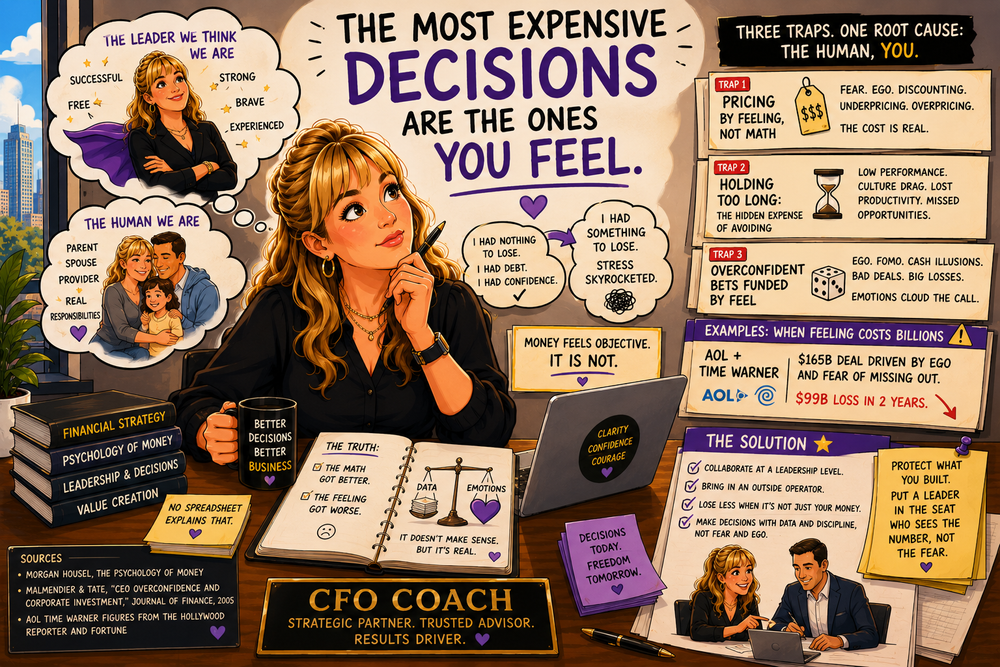
The math got better. The feeling got worse.
It doesn’t make sense. And if it can happen to me, it can happen to anyone. It isn’t about data, facts or financial literacy.
No spreadsheet explains that.
Money feels objective. It is not.
The most expensive decisions in your business are not the ones your spreadsheet gets wrong. They are the ones your gut gets wrong while the spreadsheet sits there ignored.
We all make decisions with intuition. And that doesn’t lessen as we get experience. In fact, it’s more justified at the top. With the access to data and the speed business moves, it will continue to be part of the job.
Researchers at the University of California, Berkeley studied Forbes 500 CEOs, the most rational, credentialed, incentive aligned people alive. They found the same thing. The most confident CEOs overestimated their own returns, overspent when cash was sitting in the bank, and made more deals that destroyed value. Better data and better incentives did not fix it. The distortion is in the person, not the numbers.
There are three common traps.
Trap 1: Pricing by feeling, not math
Trap 2: Holding too long: the hidden expense of avoiding
Trap 3: Overconfident bets funded by feel
Trap 1: Pricing by feeling, not math
We see leaders hesitate to change prices based purely on fear or egotism. They are scared raising prices will make clients walk. Others become convinced they’re worth more than the market is willing to pay and stubbornly operate underutilized without adjusting the value proposition to market rates.
Work is won through discounts with a focus on revenue and number of deals without stepping back and acknowledging the reality.
In many cases, the deal was already won at full price.
And in many others, the profit is stripped away by the insecurity of rash cuts.
Pricing is a decision driven by many functions. Marketing influences how we sit competitively and what the brand demands. Finance and accounting drive the number needed to achieve margins and the bottom line. Operations control the cost to deliver the work.
And yet, far too often it’s the gut and insecurity of a CEO that sets the price.
Trap 2: Holding too long: the hidden expense of avoiding
We have seen far more clients hold onto an employee longer than they should, then fire fast.
The costs are real.
Low performance impacts culture. Resistance slows growth.
The cost is ongoing and compounding: salary, lost productivity, the drag on everyone around them.
Every month you wait costs money. That’s good money after bad.
It’s also rare for a leader to cut a dying business line or a dragging client at the right time. We fail to see the data that tells us it’s time. And we ignore the evidence that redirected resources to new ideas and clients will be more profitable.
Loss aversion is a human condition.
Cutting feels like losing.
It can feel like we’ve failed.
The risk of the opportunity cost feels smaller than the change and risk of a new direction.
If we have something to lose, choosing to lose it is tough.
Trap 3: Overconfident bets funded by feel
Frequently we see one piece of data get overused and tied into emotional calls: the bank account.
The number tied to cash on hand has meaning to many leaders that is not reality.
And yet spending swings follow the bank account balance, not the quality of the opportunity.
You have seen it at the top too. In 2000, AOL and Time Warner merged in a deal worth roughly 165 billion dollars, sold as the future of media. It was driven by ego and the fear of missing out, not the math. Two years later the company reported a loss of about 99 billion dollars, the largest annual loss in corporate history at the time. One of the leaders never cashed out a single share, so sure it would come back. It did not.
We also see emotional decisions around debt, cash on hand and equity.
Overvaluing what you’ve built and being offended by the cost of equity can lead to all kinds of rash cash outflows and debt servicing.
It gets worse during transactions.
There is often a lack of understanding that earn outs have real risk.
And that vendor loans do too.
Cash in hand is understated because egos are tied to the total number, not the timing associated with it and the emotions that ride that period. Let alone the freedom of immediate liquidity versus tying yourself to a future value or collection.
Recognizing the role your emotions play in your finances is imperative.
It happens to all of us, regardless of experience, literacy or situation.
Our relationship with money is deep and misunderstood.
We don’t see it coming.
We don’t recognize when it’s taken control.
The solution?
Pricing, holding too long, and betting on feel. Three traps, one root cause: the human, you.
Collaboration at a leadership level reduces the risk of one person acting on gut.
An outside operator will be even less driven by emotions or your sway.
One study found loss aversion drops sharply when the decision is made with someone else’s money, not your own.
For example, an embedded fractional leader makes the cash, pricing and cut calls without your fear attached.
It is not a consultant handing you a report.
It is a leader in the seat making the call you can’t make clearly.
You built something worth protecting.
That instinct to protect it is exactly what clouds the call.
Put a leader in the seat who sees the number, not the fear.
Sources
Morgan Housel, The Psychology of Money.
Ulrike Malmendier and Geoffrey Tate, “CEO Overconfidence and Corporate Investment,” Journal of Finance, 2005.
AOL Time Warner figures from The Hollywood Reporter and Fortune.