The Budget Conversation to Have Before the Numbers
Don’t you hate it when budget season turns into a fight over numbers?
Sales says the target is impossible. Operations says the costs are too tight. Finance says nothing adds up.
And you’re stuck in the middle, refereeing the spreadsheet.
Here’s the thing: most budget fights aren’t about numbers.
They’re about expectations nobody agreed on.
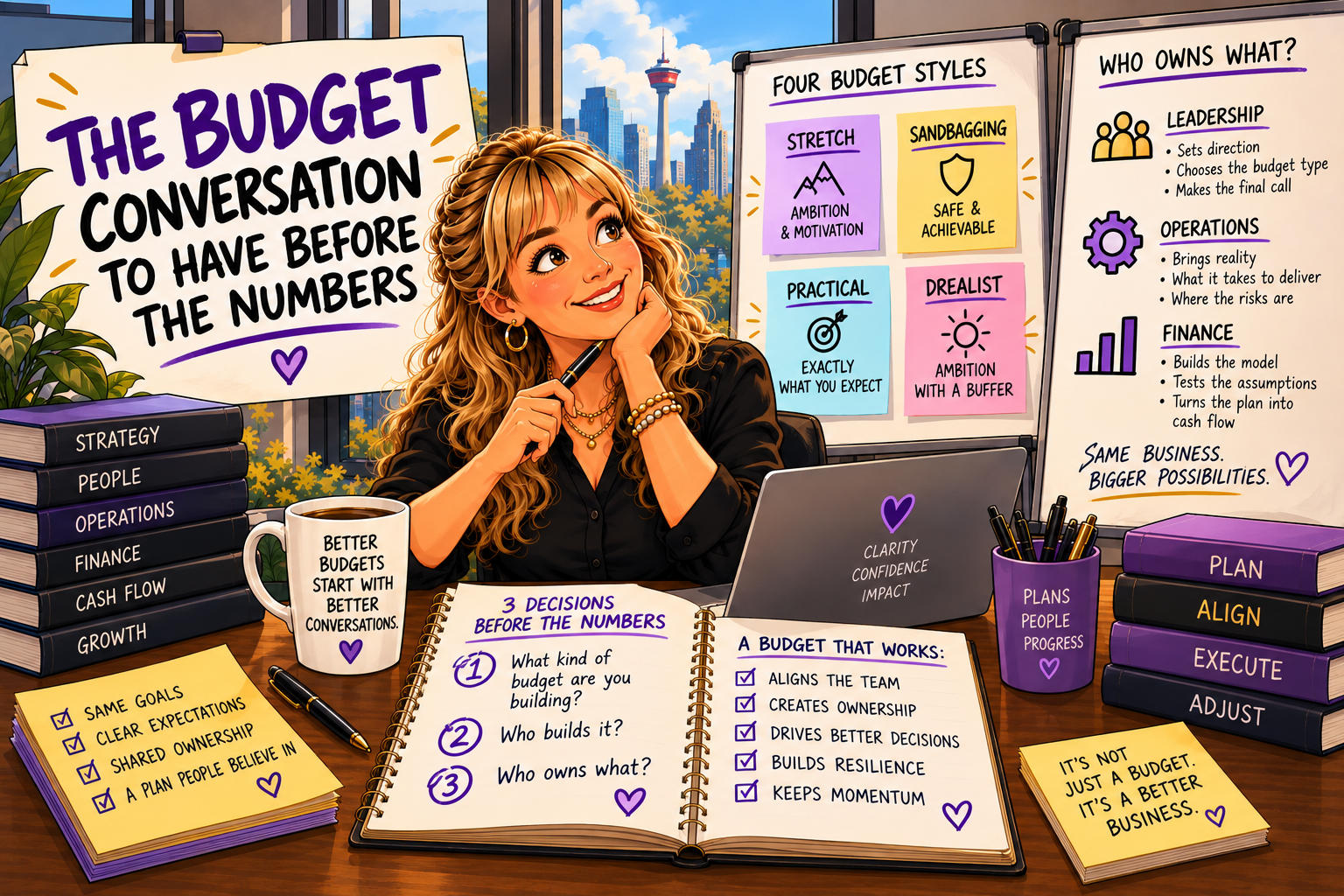
The best budgets start with a conversation, not a spreadsheet. Before anyone opens a file, make three decisions: what kind of budget you’re building, who builds it, and who owns what.
Get these right, and the numbers get easier. Skip them, and you’ll spend the next twelve months arguing about a plan nobody believes in.
It works. Just ask a CEO who tried it. A CEO I work with was heading into a difficult meeting on next year’s sales budget. He read these ideas that morning. Afterward, he told me the approach completely reset the conversation:
“We discussed the budget without talking about numbers. And then we figured out the numbers.”
One meeting. He was 90% of the way there. That’s the power of deciding before you calculate.
Decision 1: What kind of budget are you building?
Every budget has a personality. Most leaders never choose it on purpose.
There are four that I see most often:
Stretch budget. Ambitious and unlikely to be fully met. It motivates competitive, sales-driven cultures. It can demoralize everyone else. While it matches a high-performance culture, it is often how you turn a budget into an ignored tool.
Sandbagging budget. Easily achievable and built on history and known changes. It’s practical when cash or financing limits what you can chase, and it suits teams who love beating expectations. It is incredibly common. It can help people find motivation to use the tool. But a low bar, even when beaten, is almost always less than what could be possible for an ambitious business.
Practical budget. Exactly what you expect, with no ambition added and no buffer. Analytical teams thrive here because they can recalculate every number. These budgets are less common than you might think. They also end up as tools for their own sake, with less emphasis on action.
Drealist budget. My favourite. It’s the fine line between a dream and reality: ambitious, but achievable. The drealist approach is simple. Put a little stretch in revenue. Leave a lot of buffer in costs. You keep motivation high and build room for the unexpected. As long as you take the opportunity to adjust costs to actual performance, it can be one of the most useful tools. On the other hand, if you let costs stay stagnant when sales are down or vice versa when more resources are needed for exceeding performance, then you’ll have a challenge.
The decision: what behaviour do you want this budget to create? Choose the methodology that drives it.
Then choose one for the whole company. Nothing is worse than one department crushing a sandbagged budget while another tanks under a stretch plan. That isn’t a performance problem. It’s a design problem, and you created it.
Decision 2: Who builds it?
There are two main approaches.
Top-down: leadership sets the numbers.
Bottom-up: the people running the work set the numbers.
Bottom-up gets you buy-in. Your team learns their numbers and can own them in detail.
But it isn’t less work. It takes more collaboration, more review, and a team who understands the economics behind their numbers. And if leadership rewrites submissions without explanation, the buy-in disappears fast.
Top-down is faster. The cost is belief.
Push numbers on people, and you’ll hear this in March: “I don’t know. You set it. You tell me.”
For your first budget, go top-down.
Let the team hate it. Let them find the flaws. As Linda Rappoport says, “It’s easier to criticize than create.”
Then in year two, move to bottom-up or a hybrid. They’ve seen the purpose. They know what’s wrong with it. Now they’ll want in.
The decision: does your team have the experience to build this well? If not, don’t make year one the year they learn. The process you start with doesn’t have to be the one you keep.
Decision 3: Who owns what?
Budgets fall apart in the gaps between people.
Before you start, agree on three roles:
Leadership sets direction, chooses the budget type, and makes the final call.
Operations brings reality: what it takes to deliver, what’s changing, and where the risks are.
Finance builds the model, tests the assumptions, and turns the plan into cash flow.
The decision: who has final say, and who gets to push back before it’s final?
Write it down. It will save you a dozen awkward conversations.
How to run the conversation
One meeting. Ninety minutes. No spreadsheets on the table.
Start with the year. What are we trying to achieve, and what has to go right?
Choose the methodology. Stretch, sandbagging, practical, or drealist budget? Why?
Choose the build. Top-down, bottom-up, or hybrid this year?
Assign the roles. Who owns what, and who makes the final call?
Define “useful.” What decisions do we need this budget to help us make by March?
Walk out with answers to all five, and the numbers have somewhere to land.
It’s okay if it’s not right.
The hardest part of a budget is accepting it won’t be perfect. It doesn’t have to be. A budget isn’t a prediction. It’s a decision tool. The value is in the choices you make because you planned.
So before the numbers, make three decisions:
What kind of budget are you building?
Who builds it?
Who owns what?
Then go figure out the numbers.
Next in this series: How to Build a Small Business Budget You’ll Actually Use to Decide.
Jamie L Smith