Your Bank Balance Is Not a Forecast (Working Capital Part 3)
Your Bank Balance Is Not a Forecast (Working Capital Part 3)
There is nothing more frustrating than having revenue and sales while being cash poor.
Except having revenue, sales and profit while still being cash poor.
Every finance leader has been in that room. Sometimes we are the one explaining it. Sometimes we are the one who did not see it coming.
More than eighty percent of businesses that fail point to cash flow as the main reason. Not demand. Not product. Cash.
In Part 1, we covered why working capital is cool again now that money is expensive. In Part 2, we covered why it is a team sport and why financial literacy sits with the Chief Financial Officer.
Part 3 is the levers. And in Part 4, we talk mechanics.
Bottom line:
Cash pressure during growth is normal - every growing business manages cash challenges. That is not a distress signal. The difference is only if it is managed or becomes a problem;
your bank balance is not as useful as you think. That number is not telling you where you are at or what is coming;
Meanwhile, a cash forecast is a strategy tool, not just a reporting chore.
Let’s explore all three.
1. Growth will make cash challenging
Cash flow difficulty is treated as a symptom of a dying company. Most of the time, it is the opposite.
With growth, patterns change and become more complex and volatile.
Here is why:
- New customers pay on different rhythms than your existing base.
- Larger clients and larger orders come with negotiated terms, master service agreements, and conditions that push collection further out.
- They also put larger pressure on the inventory, labour and overall costs of delivering on the contract or order because of their size.
- New geographies and new industries carry their own payment norms.
- Volume inherently results in volatility. More transactions mean more variance.
- New vendors arrive with their own terms and conditions.
- And larger, more established vendors will have higher standards for credit, master service agreements and payment.
- As you move away from credit cards and start to negotiate terms and partnerships that are more strategic, the maturity will add complexity.
It is funny, because this is predictable and happens in all industries. As businesses grow, liquidity changes, and much of that is more challenging. It is not distress. Yet it can be stressful if you don’t expect it or manage it.
Which is the point. Your job is not to explain the pattern after month-end. Your job is to see it before it lands.
2. The bank balance is the most confidently wrong number in your business
Someone in your organization checks the bank balance and forms an opinion about the company’s health.
It is not unusual for an owner to open the bank app as part of their daily routine. As we discussed in Part 2, financial literacy is lacking, so leaders who haven’t been taught about working capital may also use the bank balance as a key performance indicator or useful metric.
Meanwhile, the number you see is changing every day. The balance moves and doesn’t account for the money you already owe or have spent. Payroll clears, a supplier gets paid, or payables pile up. It also doesn’t reflect the services and products you’ve sold and earned but have not yet collected. A large receivable lands, a deposit is refunded or new retainers are collected. None of that tells you what next Tuesday looks like. It doesn’t even tell you much about today.
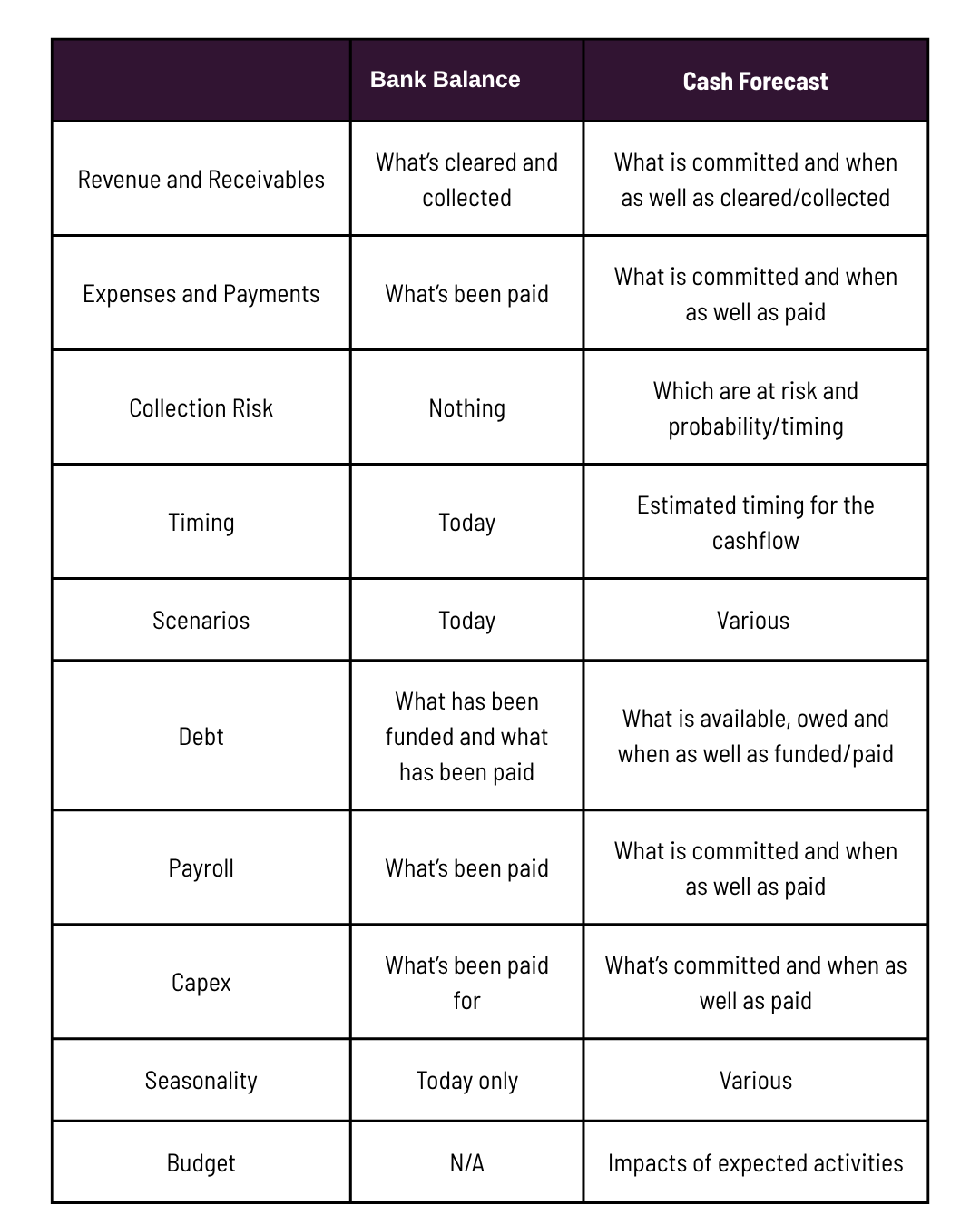
To build useful cash flow forecasts, you need
timely bank reconciliations,
accurate month-end reporting,
real knowledge of the business and its stakeholders,
and historical trends to lean on.
Rolling weeks, seasonality, and prior year are all useful data points that help you predict the future, and they’re more readily available if you have strong accounting routines and record-keeping. An annual budget or forecast strengthens it further.
The better your books and records, the better your history. The better your history, the better your prediction.
And your prediction- your cash flow forecast is the magic that needs to be at the source of decision-making across the business.
3. Forecasting is strategic, not administrative
As we’ve illustrated, the treadmill of accounting and the routine tasks of month-end close, bank recs, and record-keeping make a difference when we go to forecast. Far too often, the exercise of updating the forecast becomes another item on that list. Get it done. Check it off. Move to the next.
This is where finance leaders lose the plot. The forecast gets treated as a compliance task instead of a negotiating position and a business tool.
A current cash forecast changes how you make decisions. It should be a tool that changes how leaders show up.
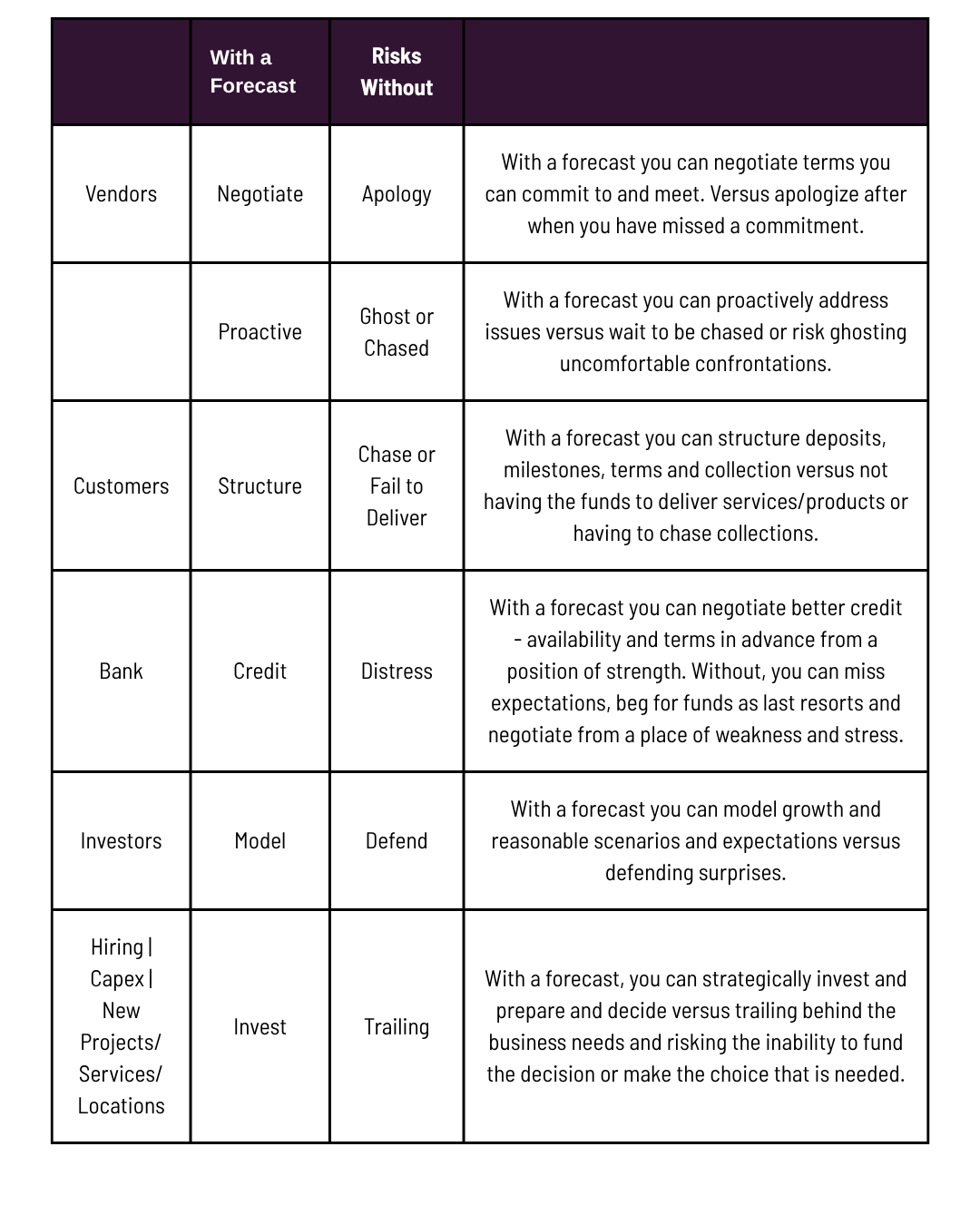
Forecasting is not about being right.
It is about having direction and knowing where the pain points sit, so you can make the call with your eyes open. This one is tough for a lot of Controllers and is a key difference between a CFO and Finance Leader. When you ‘grow up’ having to be accurate and correct - with compliance and month-end and going through audits from both sides- you value being right. And when leadership roles demand something different. And when leadership roles require you to be wrong consistently yet still be confident in recommendations, discussions, and challenges, it is a new skill.
A forecast is just a business plan in numbers. A cash flow forecast includes timing and liquidity at a reasonable level.
Knowing you did a good job with a forecast depends on whether the team used the tool, considered the risks, and had information that was directionally and materially reasonable. If the actual outcome is within the range of the estimate and the variance would not change the decision-maker’s mind, then you did well.
How to actually build it
Work in this order:
1. Bank reconciliation.
2. Payroll.
3. Committed payments with fixed timing, including debt service and lease obligations.
4. Accounts payable, both invoices and payments, scheduled against negotiated terms.
5. Accounts receivable, forecast by estimated collection and past behaviour rather than invoice date.
6. Forecast sales. Start with the budget but adjust conservatively.
7. Forecast cost of goods sold and operating expenses. Again, start with the budget, adjust for changes in the sales forecast, and add a buffer.
8. Scenario plan for growth moves such as hiring and capital expenditures.
9. Update it before any significant cash outflow, not after.
Then decide your cadence. Daily, weekly or every two weeks. There is no correct answer. It depends on what is happening in the business right now, and it should change when the business changes.
One funny thing. It can be easier and take less time to do it more often. I’ve seen many Finance Leaders forecast cash daily, long after cash and liquidity needs required it. Taking ten to thirty minutes daily can be easier than blocking a longer window once a week, month, or at another cadence.
Decide the timeframe to work with. Your timing cash flow forecast could be 13 weeks - that’s best practice, as it covers a full quarter end but is short-term enough to be accurate. For most decisions, it is still long-term enough to be strategic. Anything further out is harder to predict with enough reasonableness to stand behind. Yet, much shorter means you are thinking reactively.
Even if you are not under cash pressure and not raising capital, keep a routine. The forecast is most valuable when something unexpected shows up.
What changed is how often you update it, not whether it exists.
Two cautions
Be careful who owns this.
A bookkeeper or accountant can produce the file and make the basic updates. They're less likely to have he strategic context or business knowledge to make it useful. The scenarios and assumptions need to align with the business and strategy, which leadership holds.
Use the tools.
Software such as Float, Cashflow Frog, QBO Cashflow Planner and many others will connect your cash forecast to your bank and your accounting system. Nowadays, you can also work with Excel and basic LLM AI. You get visual insight, quick scenario testing, and short- and long-term views without rebuilding a spreadsheet every week.
The takeaway
Cash challenges in a growing business are normal. Expect them as you grow, and there is no need to feel ashamed.
Your bank balance is a snapshot, not a forecast.
The forecast is a leadership tool, not a finance chore.
If you are a Chief Financial Officer whose reports are accurate and timely but not being used or changing decisions, start here. A forecast that people understand and act on will do more for your credibility than another dashboard ever will. And most can’t read the financial statements anyway.