Quick answer: Good board reporting goes past what happened. Every report to your board, investors, banker, or leadership team should cover four lenses: performance, outlook, strategic implications, and decisions. Most reports stop at performance. When something changes, the finance leader walks the room through what changed, why it matters, which assumptions no longer hold, what the options are, and what they recommend.
This is where most finance meetings go wrong.
They spend the hour explaining what happened. You’ll hear the reasons, from timing to one-offs. You may hear vague predictions: it’ll catch up next quarter. The entire meeting is everyone explaining. Yet nobody is deciding.
Boards are asking for the opposite. The NACD’s 2026 Blue Ribbon Commission report pushes board materials away from status updates and toward real insight that helps directors judge progress and catch concerns early. And boards are spending more time on strategy than ever: 70% of public company directors and 49% of private company directors say strategy discussions have become more frequent.
What should every board report cover?
Every report to your board, your investors, your banker, or your own leadership team should cover four things:
| Lens | The question it answers |
|---|---|
| Performance | What happened? |
| Outlook | What’s likely to happen next? |
| Strategic implications | What does it mean for the strategy? |
| Decisions | What should we do differently? |
Most reports stop at the first one. The value is in the last three.
What should you do when something changes?
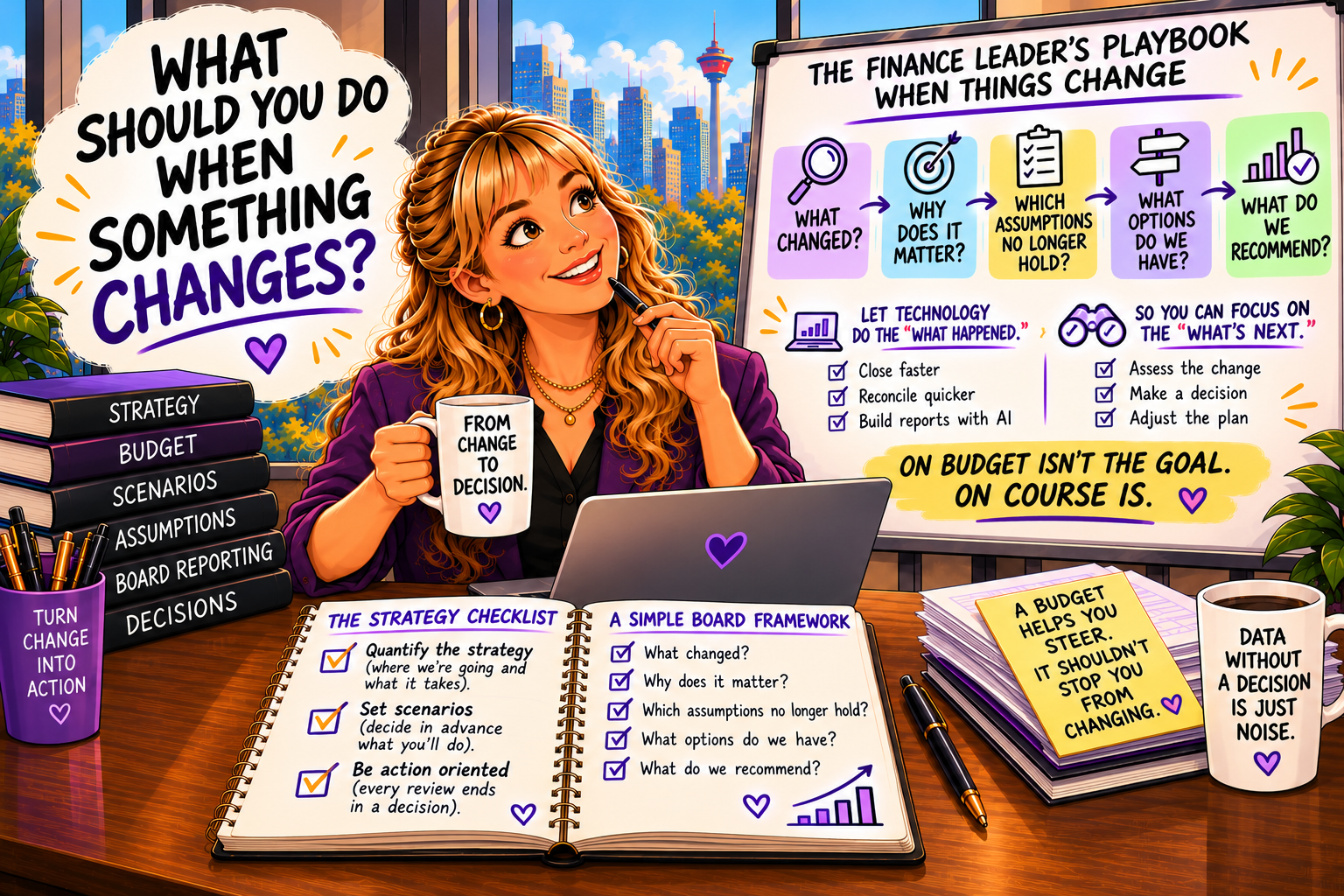
When something changes, the finance leader’s job is to walk the room through it:
What changed?
Why does it matter?
Which assumptions no longer hold?
What options do we have?
What do we recommend?
If you’ve started the monthly review habit from the budget series, you’re halfway there. Those questions push the team toward action. This takes the same habit up to the strategy level. And if you wrote down your assumptions in Part 3, question three answers itself.
How should technology change board reporting?
Technology should buy back time for judgment.
Accounting software and artificial intelligence (AI) can now produce the “what happened” faster than ever. Closing, reconciling, and building variance reports take less effort every year.
That time shouldn’t disappear into more reports. It should go to the conversation that matters: what changed, and what we’ll do about it.
Why is this a core skill for finance leaders?
If you lead finance, read this part twice.
Framing a strategic decision for a board is not executive polish. It’s a core skill.
The finance leaders who will lead in the next few years are the ones who can stand in front of a board and say: here’s what changed, here’s what it means, here are our options, and here’s what I recommend.
Data without a decision is just noise, and that is expensive clutter in a world of AI, endless information, and access.
Your budget is there to help you steer, but don’t hide behind it
Your budget isn’t the strategy. It’s year one of it.
When the facts change, the budget should change with them, and so should the way you talk about it.
Quantify the strategy, so you know where you’re going and what it takes to get there.
Set scenarios, so you’ve decided what to do before you need to.
Be action oriented, so every review ends in a decision.
On budget isn’t the goal. On course is.
If you want coaching to build a financial strategy, or to get your finance team reporting forward, reach out.
New to the series? Start with Part 1: Your Budget Might Be Keeping You on Yesterday’s Strategy.
Jamie L Smith