Quick answer: Strategic budgeting means your budget serves your current strategy, not the assumptions you held when you built it. A budget allocates people, money, and attention at one moment in time. When the market shifts, a clean budget variance analysis can confirm you’re on plan while the plan itself has gone stale. The fix takes three moves: quantify the strategy, set scenarios, and make every review action oriented.
Don’t you hate it when the business hits budget, and you still have a nagging feeling you’re headed the wrong way?
The numbers are on plan. The variance report is clean. Everyone’s relieved.
But the market moved. A key customer is wobbling. Input costs aren’t coming back down. The opportunity you talked about in January has either passed you by or doubled in size.
And the budget? It’s still running last year’s thinking with precision.
Here’s the truth: you can be on budget and off course.
Why are boards worried about budgets?
Boards are noticing. The National Association of Corporate Directors (NACD) released its 2026 Blue Ribbon Commission report on board oversight of strategy execution on October 12, and it found that periodic reviews built on backward-looking metrics can’t keep up anymore. Strategy is getting more airtime, too. In NACD’s 2026 Governance Outlook Survey, 70% of public company directors and 49% of private company directors said strategy discussions have become more frequent in the boardroom.
The report’s message applies well beyond the boardroom. Backward-looking financial metrics can tell you what happened. They can’t tell you whether your strategy still holds. Conditions can shift mid-course, not just at the next planning cycle. And a budget built on last year’s assumptions keeps funding last year’s plan.
That’s the trap.
A budget should help you execute your strategy. It shouldn’t stop you from changing your strategy when the facts change.
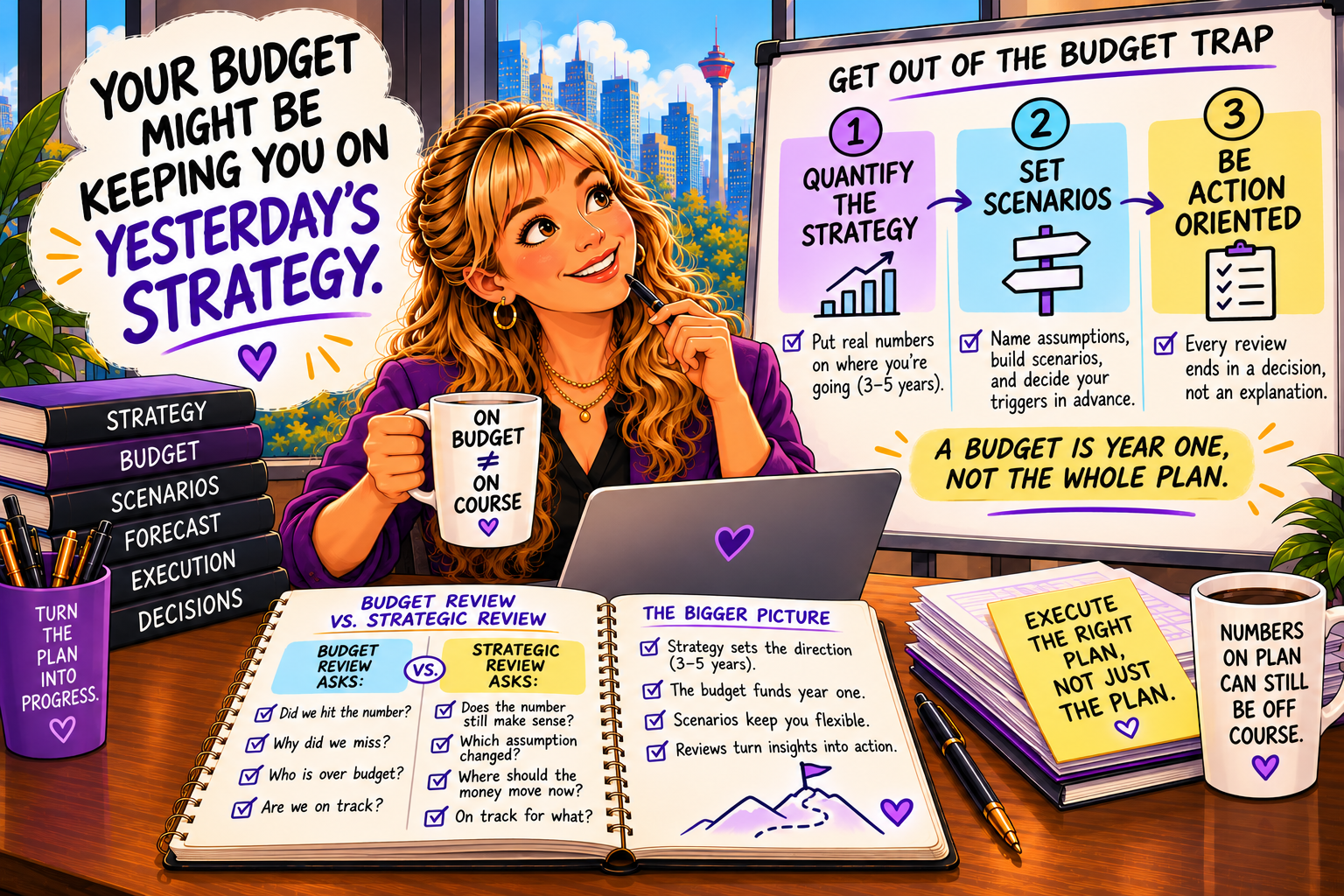
How does a budget lock in last year’s strategy?
A budget is built at one moment in time. It reflects the strategy, the market, and the assumptions you held that fall.
Then it does exactly what it was designed to do. It allocates people, money, and attention, and it holds everyone accountable to that allocation.
The issue is that if we had the crystal ball to predict how the world would shift, we wouldn’t be in a business that needed a budget!
The sales team keeps chasing the segment the budget funded. Operations keeps hiring to the volume the budget assumed. Marketing spend keeps flowing to last year’s channels. And every month, the variance report confirms you’re on track.
On track for what?
An accurate budget variance analysis tells you whether you did what you planned. It can’t tell you whether the plan still makes sense.
Many of the leaders we work with struggle with exactly this. They aren’t careless. They’re disciplined. They’re just being disciplined about the wrong thing.
What’s the difference between a budget review and a strategic review?
The difference shows up in the questions each one asks:
| A budget review asks | A strategic review asks |
|---|---|
| Did we hit the number? | Does the number still make sense? |
| Why did we miss? | Which assumption changed? |
| Who is over budget? | Where should the money move now? |
| Are we on track? | On track for what? |
If your monthly meeting only asks the first set of questions, start with the seven questions from our budget series. They move the room from explaining to deciding.
How do you get out of the trap?
Getting out of the trap takes three moves:
Quantify the strategy. Put real numbers on where you’re going, three to five years out.
Set scenarios. Name your assumptions, build scenarios, and decide your triggers in advance.
Be action oriented. Every review should end in a decision, not an explanation. Focus on the future, not on explaining or justifying the past.
Each move gets its own post in this series. Your budget stays. It just stops being the whole story.
Your budget is year one, not the whole plan
If you’ve been following the budget series, you know a budget is a decision tool, not a report card. And you know it’s one of three tools a growing business needs, alongside the cash flow forecast and the financial strategy.
This series picks up the third one. Because a budget without a strategy behind it will keep you executing last year’s plan with impressive precision.
On budget isn’t the goal. On course is.
If you want coaching to build a financial strategy, or to get your team out of the budget trap, reach out.
Next in this series: Profitable Isn’t Fundable. Why your business needs a financial strategy.
Jamie L Smith