Stop Explaining Variances. Start Making Decisions.
Don’t you hate it when the monthly finance meeting turns into story time?
“We missed because of timing.”
“That cost was a one-off.”
“It’ll catch up next quarter.”
Everyone explains. Nobody decides.
You’re not alone. Vena’s 2026 survey of more than 400 finance leaders found that finance teams are producing valuable insights, but businesses struggle to turn them into action.
Here’s the truth: a budget you don’t use to make decisions is a very expensive history lesson.
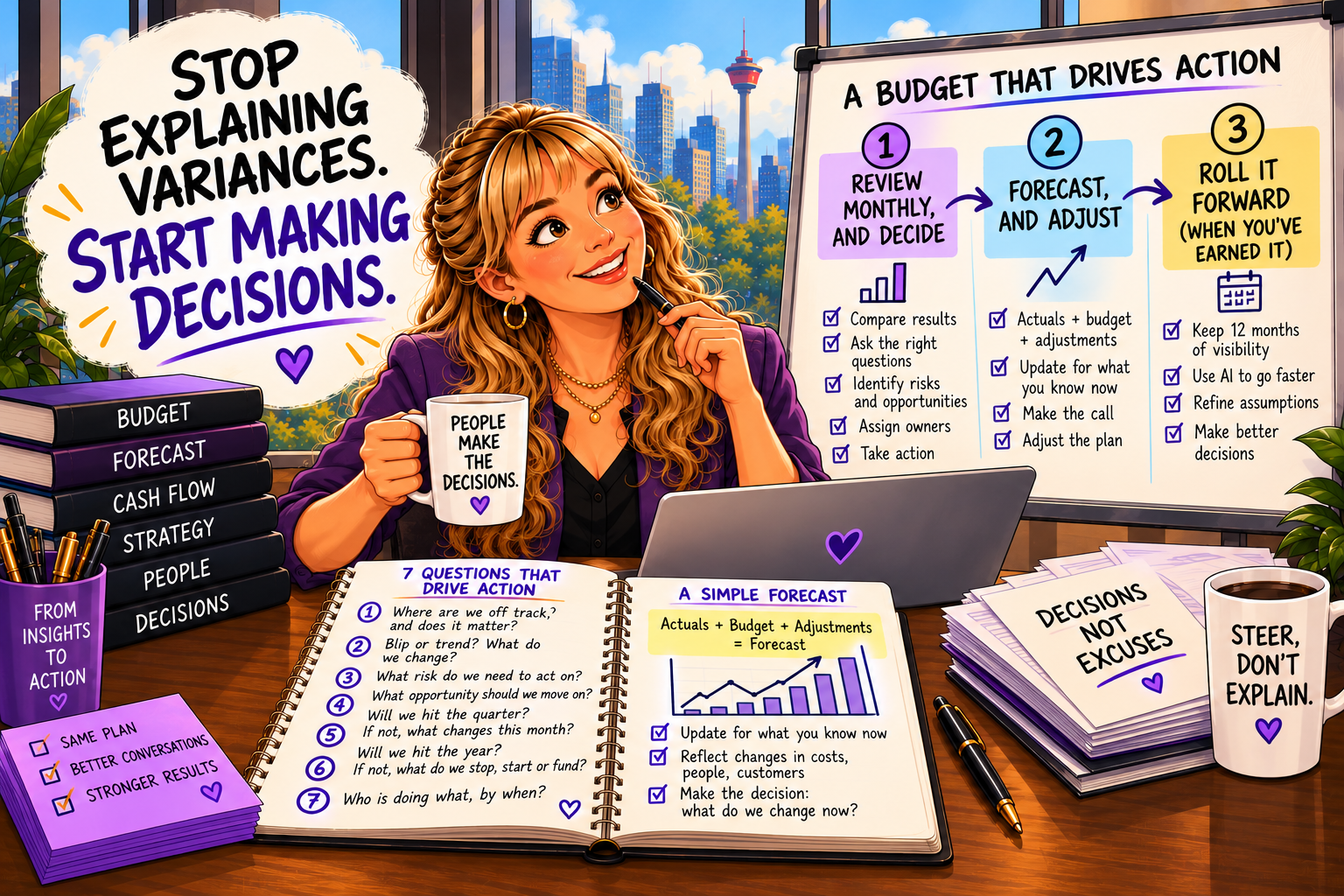
Your budget should help you steer. That happens in three stages:
Review monthly, and decide.
Forecast, and adjust.
Roll it forward, when you’ve earned it.
Stage 1: Review monthly, and decide
Do not set a budget and forget it.
Meet monthly. Compare results to budget and to last year.
Then ask seven questions. Notice that we are driving action, not explanation.
Where are we off track, and does it matter?
Is this a blip or a trend? If it’s a trend, what do we change?
What risk do we need to act on now?
What opportunity should we move on?
Will we hit the quarter? If not, what changes this month?
Will we hit the year? If not, what do we stop, start, or fund?
Who is doing what, by when?
Do you see the difference? We didn’t review that revenue was up or down because sales were increasing or decreasing. We didn’t talk math. We addressed history in the context of what is next.
It is not a history lesson or update. It is not a discussion and a collaboration of excuses. It is a leadership review.
Start simple. These seven questions are a new habit. Build the rhythm before you add anything else. You are creating the expectation that you will stop accepting rationales and start expecting forward-thinking discussions. Don’t leave the room without clear action points, assigned.
Stage 2: Forecast and adjust
Once the monthly rhythm sticks, turn your budget into a forecast.
The simplest starting point: actuals plus budget plus adjustments.
Actuals (to date) + Budget (remaining) + Adjustments = Forecast
Say you just closed the first quarter. Take January, February, and March actuals. Add the budget for April through December.
Then adjust for what you know now:
Inventory costs are running 5% higher and won’t come down this year.
You hired a key role that wasn’t in the plan.
A major customer signed early, or left.
See? When you have a budget, most of the hard work is done.
The decision the forecast forces: based on where we’re really landing, what do we change now?
Stage 3: Roll it forward, when you’ve earned it
Here’s where I’ve changed my thinking.
The annual budget is getting dated.
It’s built once, based on assumptions that start going stale in weeks. By spring, you’re managing to a plan that no longer matches the business.
A rolling forecast fixes that. Every month, you replace that month’s forecast with actual results and add a new month at the end. You always have twelve months of visibility ahead of you.
Rolling forecasts used to require a finance team with time most small businesses didn’t have.
Artificial intelligence (AI) changes that.
And it’s probably already in software you pay for. Major accounting platforms now include AI that helps forecast cash flow, and some project your position 90 and 180 days ahead based on outstanding invoices and historical patterns. The work that made rolling forecasts unrealistic for small businesses is shrinking fast.
AI makes rolling forecasts possible. It doesn’t make them right.
Plenty of finance teams are investing in AI without seeing the payoff. A Gartner survey of finance leaders found that most are implementing or planning to implement AI, but only 7% report a high or very high impact.
Why? Because AI can’t fix what isn’t there.
Before you forecast, you need three things:
A reliable monthly close. If your books are late or wrong, AI forecasts faster from bad data. Even the software tells you this: AI can match and categorize transactions, but it won’t close your books. Someone still has to.
A year of monitoring. You need to know how your business behaves against a plan before you let a plan move every month. The muscle memory of the stage one discussions is what makes the assumptions and the forecast worth it.
A handful of drivers you understand. Volume, price, customers, capacity. The few numbers that actually move your results.
Have those? Roll it forward.
Don’t? Keep building the habit. You’ll get there faster than you think.
People make the decisions. AI may draft the forecast but you decide what to do about it and who will take those next steps.
Steer, don’t explain
Your budget was never meant to be a report card.
It’s how you lead.
Review monthly, and decide.
Forecast, and adjust.
Roll it forward when you’ve earned it.
Stop explaining variances. Start making decisions.
Next in this series: Cash Flow Forecast, Budget, or Financial Strategy? You Need All Three.
Jamie L Smith